Horizon Review, an annual arts publication, features “They Had No Time to Say Goodbye!”
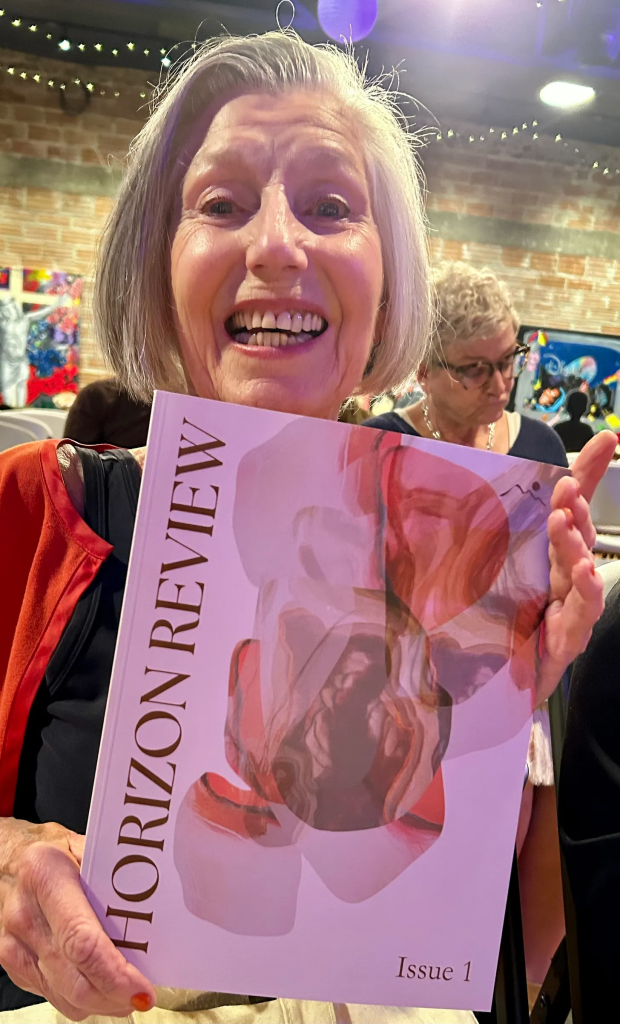
We are honored that our “They Had No Time to Say Goodbye” collective is featured in an in-depth article in the inaugural edition of Horizon Review. This is an annual arts publication put out by FUSION Albuquerque. The launch party in April was everything we hoped it would be, in spite of a partial brown-out (when visibility is limited because of dust storms—a common phenomenon in the high desert). The launch party started with many of those whose work is included in the magazine: writers, visual artists, and a musician, sharing their work. Our collective, consisting of Kimberly Wahpepah (Diné), survivor of sex trafficking, now an advocate of sex trafficked Indigenous people, Sandi Ludescher, figurative painter, Linda Piper, Black activist, theater director, writer, and storyteller, and myself, were present to enjoy this joyful event.
Our presentation consisted of me giving a brief description of “They Had No Time To Say Goodbye,” our multimedia collaborative art project about the crisis of missing and murdered Indigenous women. Kimberly followed me. She talked about her experiences of being trafficked. She then appealed to the audience to help in our efforts to create an awareness of missing and murdered Indigenous women as well as those who are trafficked. Meanwhile, Sandi stood alongside us on the FUSION stage holding her painting of Mona Vallo, a Native woman whose body was found on Route 66, apparently the victim of a hit-and-run. The perpetrator of the crime has not been apprehended. Mona was a resident of Acoma, New Mexico.
Linda Piper, the fourth member of our collective, whose poem is featured in the article, videoed our presentation. Watch for the video on my website soon.
Kimberly, in her talk, spoke of her own experiences of being trafficked and addressed some of the issues surrounding the crisis of missing and murdered Indigenous people. A summary of these issues is included in the Horizon Review article: “In March of 2024, the New Mexico Department of Justice launched a portal for Missing and Murdered Indigenous People, which provides users with the most up-to-date information on cases in the state and surrounding areas. As of the writing of this piece, 200 Indigenous people are on this list that have been reported missing and still have yet to be found. Many of those missing have become victims of sex trafficking. Native American women in particular experience disproportionately high rates of violence, disappearances, and murder, up to ten times more than the national average. For many, these women exist only as missing persons posters at their local grocery store. Sex trafficking and kidnappings are nothing new in areas of the Southwest, and certainly the U.S. as a whole, yet those in our most vulnerable communities bear the brunt, being more aggressively targeted. Beyond those communities, people typically only relate to them as cautionary tales that, although frightening, don’t linger in their daily lives. However, one small moment of looking without turning away—and one decision to do something about it—can bring remarkable change.1”
L to R: Linda Piper and myself with a copy of the Horizon Review. Kimberly Wahpepah and Sandi Ludescher with the “They Had No Time To Say Goodbye” book. Portrait of Mona Vallo by Sandi Ludescher, one of several she is painting of missing and murdered Indigenous women. Spread from the article in Horizon Review.
To date, over 150 artists and others from the world over—Asia, Europe, Canada, Mexico and throughout the USA—have either etched X-rays or have committed to etching X-rays. These images depict the countless anonymous Indigenous women who go missing without a trace.
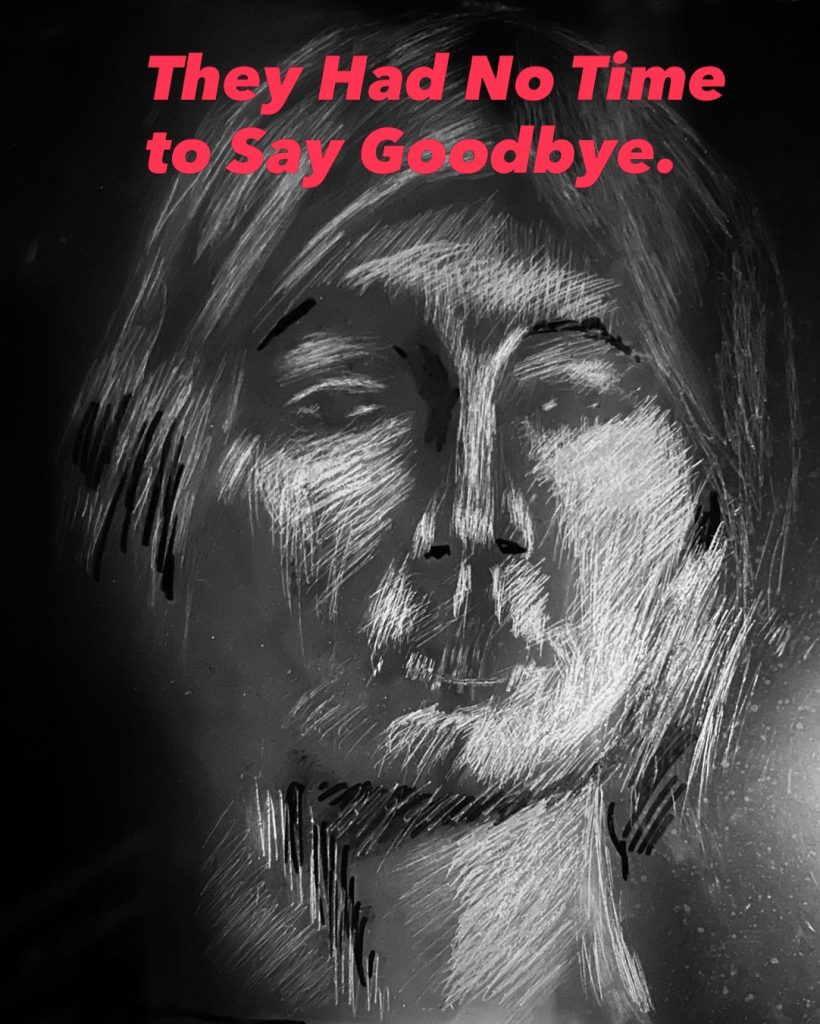
This image of an Indigenous woman was etched on a 9” x 8” X-ray by Taylor Spence of New Mexico.
If you would like to participate and help us get the word out about the MMIW crisis, please get in touch with me. Etching an X-ray is a simple process, no special supplies needed. A screw driver or dremel tool can be used to etch the x-ray on a light box, but a dull pair of scissors and a glass window pane works just as well. Every participant will be acknowledged in our exhibitions. If you are one of the people to whom we’ve mailed an X-ray, please finish etching it ASAP and mail it back before Friday, June 26. We will add red paint to the X-rays during a paint get-together at my studio at the beginning of July. Red signifies the MMIW movement. If you’ve changed your mind about etching it, please mail it back as X-rays are expensive, and hard to come by these days!
Scroll to the end to see instructions for etching an Indigenous woman’s face on an X-ray
In May, I participated in the Little House Auction at Off Center Arts in Albuquerque. There were hundreds of wild, whimsical, and fanciful little houses! I was delighted that my little house “Whistling All The Way Home” was one of those that sold to benefit this very worthy cause.
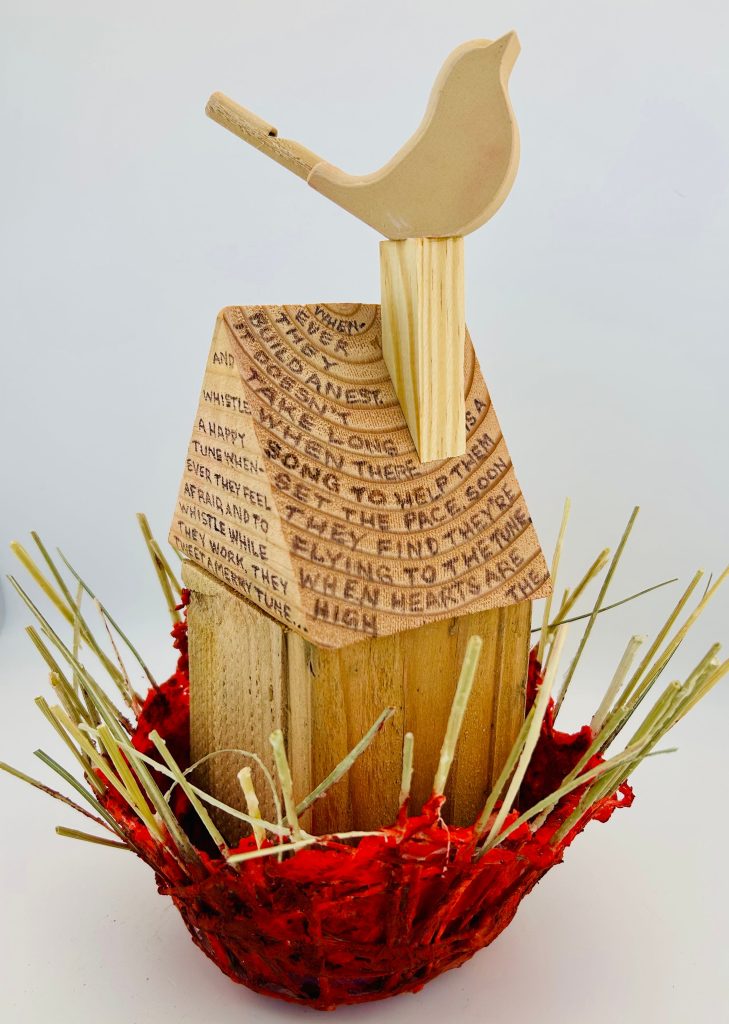
“Whistling All The Way Home,” wood, paper, grass, cold wax medium, acrylic paint, and 3d printed whistle
Saturday, June 6th, I attended the opening of INSPIRATION at the Museum of Encaustic Art in Los Cerrillos, New Mexico. I am delighted to once again have my work included in a national juried exhibition at this fun and fabulous museum! The exhibition will be up until August 9th.
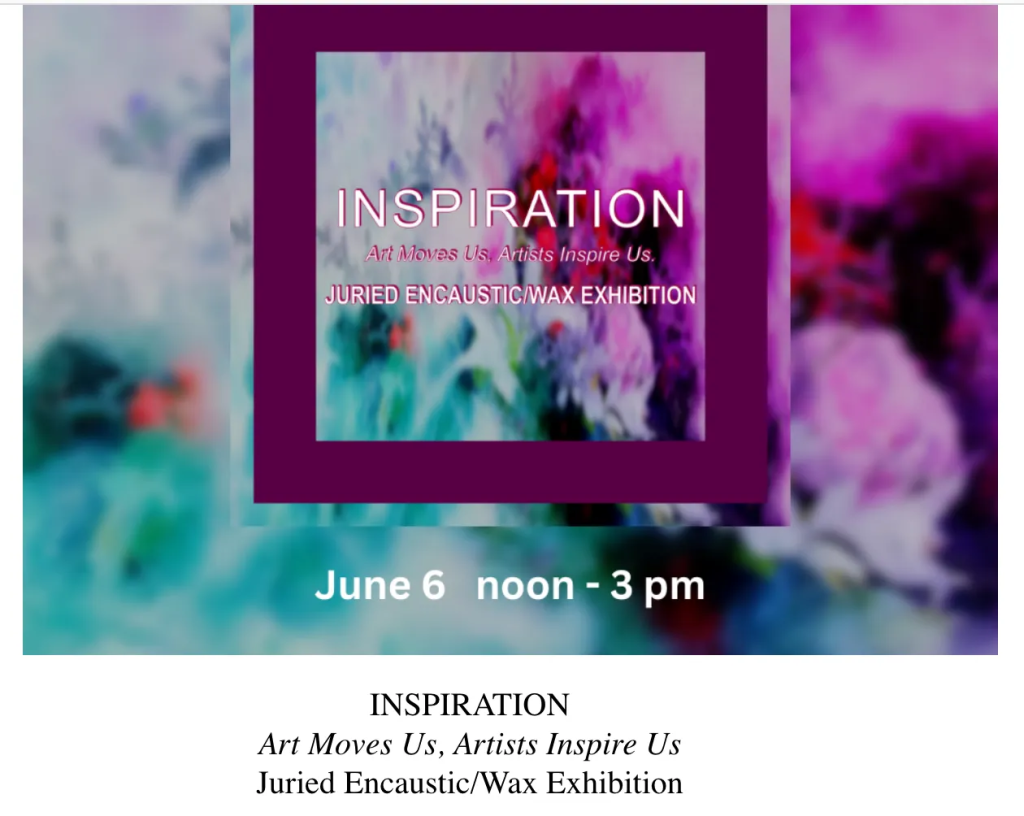
Online sales went live June 5th.
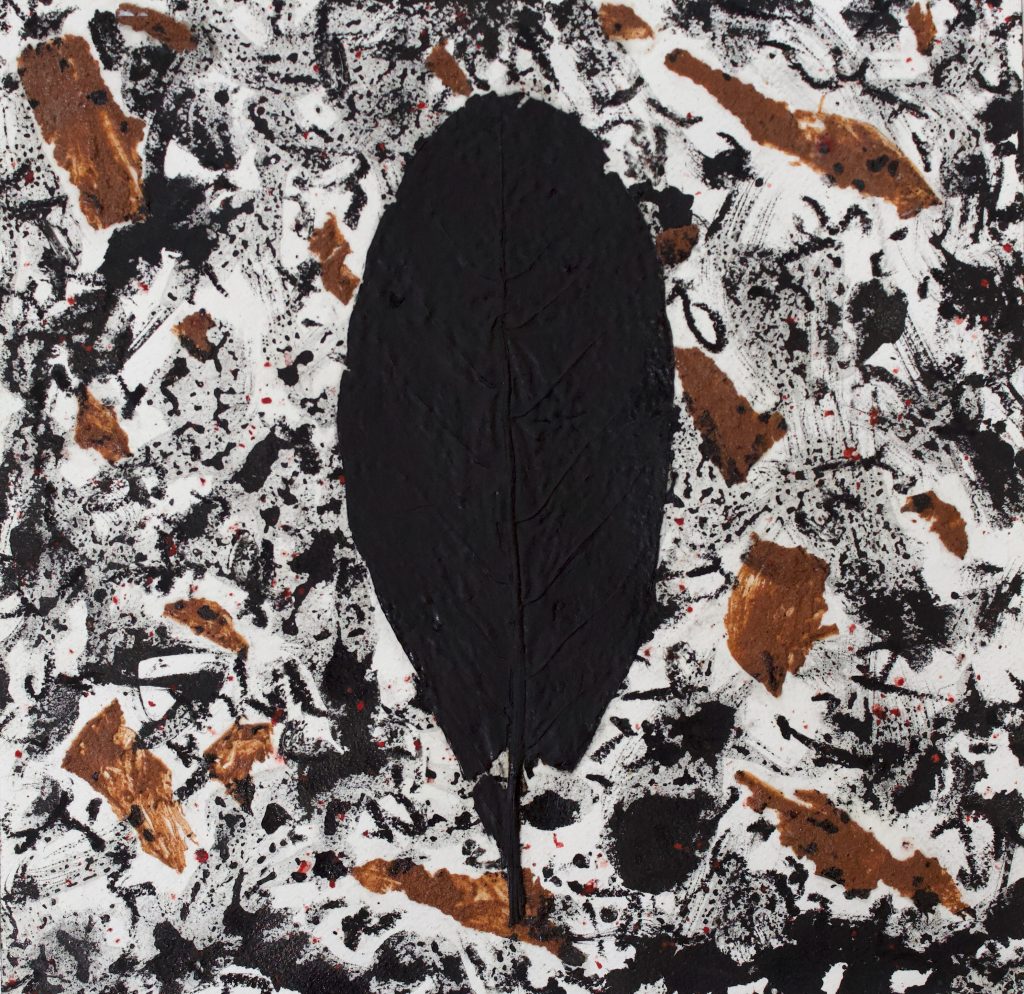
Beleric Myrobalan from the “A Leaf in the Wind” series. Leaf picked in India, cold wax, soil from Abiquiu, Sumi ink, acrylic paint on paper. 22’’ by 18’’ framed
My next painting course starts on Wednesday, June 17th, 5pm MT, 7pm ET, online and in my studio. Learn to paint with oils, acrylics, watercolors, or mixed media. Each class lasts two-and-a-half hours. Each painting session is six weeks long, and costs $100 for six weeks, or $20 per class. “As a facilitator Rose Marie has awesome information and experience!” “I very much enjoyed her sharing her gifts with us. I learned tons from her.”
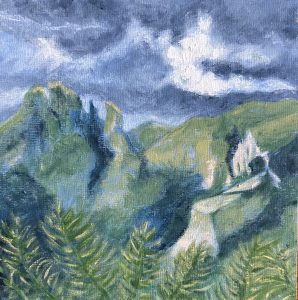
Arizona mountains, acrylic on panel by Colette Bancroft. Colette has been one of my painting students for over two decades.
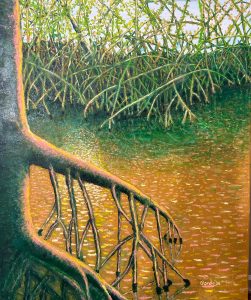
Mangrove swamp, oil on canvas by Ron Everest. Ron has been one of my painting students for over two decades.
On June 26th I am conducting a “They Had No Time to Say Goodbye: FREE Learning and Art-Making Activity” at the Groove Artspace on Friday, June 26, 10am to 12:30pm. Linda Piper will join me. The Groove Artspace is located at 309 Gold Ave SW in Albuquerque. Donations to cover costs gratefully accepted.
Participants in “They Had No Time to Say Goodbye” workshops etching X-rays in Tomar, Portugal, and Albuquerque
Thank you for offering to contribute your time and talent to help make our collaborative multimedia art project, They Had No Time to Say Goodbye, a success by etching an Indigenous woman’s face on an x-ray. We appreciate every contribution to They Had No Time to Say Goodbye. Every participant will be acknowledged in our exhibitions.
Before you start, please view the video explaining the project.
1. Find the face of an Indigenous woman you want to work with. Here’s a link to one option: https://www.shutterstock.com/search/native-american-woman-face (Please don’t use an actual MMIW as we need to respect the grieving family’s privacy.)
2. Draw the face on tracing paper with a dark (4B, 6B or ebony) pencil, or black marker, so it will fit onto the x-ray, final size = 9” x 7 7/8” (Your image MUST be vertical.)
3. Tape the tracing paper to your light box or a window.
4. Tape the x-ray over the tracing paper and, using a pair of dull pointed scissors, Phillips screw driver or dremel tool, etch the lines of your drawing onto the x-ray.
5. When you have completed the process of etching the lines of the face, remove the x-ray and the tracing paper.
6. IMPORTANT! Flip the x-ray over, and tape the back to the light box or window. Now etch over all the lines you etched on the front so light shines through the marks defining the Indigenous woman’s face.
7. When you think you’ve etched all the lines, hold the x-ray up to the light to be sure all the lines on the front are etched on the back.
Please mail it to me. My address is:
110 Richmond Drive SE, Unit 209, Albuquerque, NM 87106
Should you decide you would rather not participate, please mail the unused x-ray to this address so someone else may use it.
Note: We will add the red color to the X-ray so the color is uniform.
Yours creatively,
Rose Marie
- Tracey, Morgan Leanor, Leah Livingston, and Jeanette DeDios, “Our Chance to Say ‘Enough:’ Profile on ‘They Had No Time To Say Goodbye,’” Horizon Review. issue 1, 2026.